
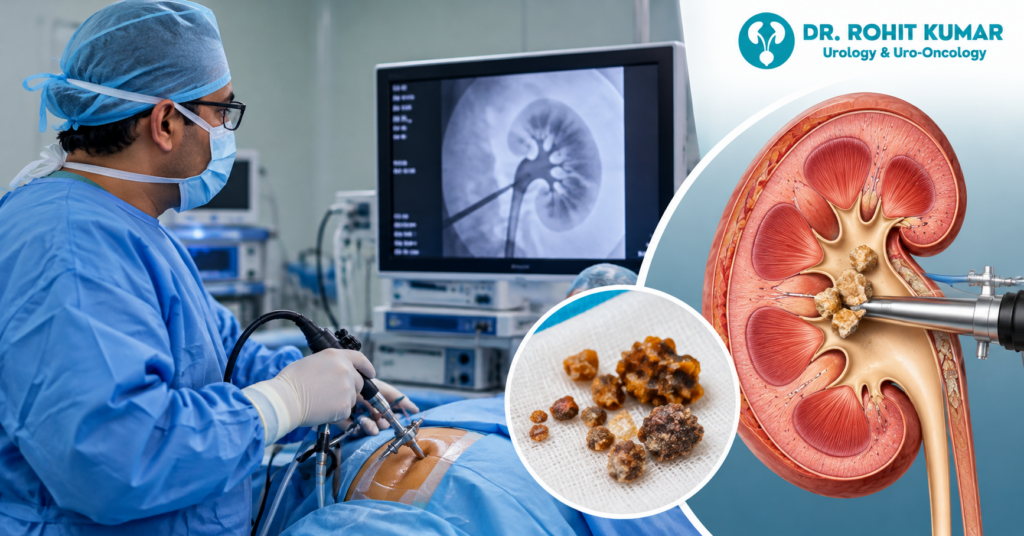
Large kidney stones can cause severe pain, urinary obstruction and recurrent urinary tract infections, particularly when they cannot pass naturally through the urinary tract. PCNL surgery is one of the established minimally invasive procedures used to remove larger/complex kidney stones.
Dr. Rohit Kumar, Consultant Urologist & Andrologist in Noida, provides specialist evaluation and treatment guidance for patients with kidney stones, including cases where minimally invasive stone removal may be appropriate.
If you are considering PCNL surgery in Noida, want to know when PCNL is needed, how the procedure is performed, how to prepare, and what recovery is like—so you can make an informed decision about your treatment.
Important: The choice of kidney stone treatment depends on factors such as stone size, location, number, anatomy, urinary obstruction, infection and the patient’s overall health. PCNL is not automatically the right treatment for every stone.
What Is PCNL Surgery?
PCNL (Percutaneous Nephrolithotomy) is a minimally invasive procedure used to remove kidney stones through a small access tract created through the skin into the kidney.
Unlike traditional open surgery, PCNL does not require a large abdominal incision. A urologist uses imaging guidance to access the kidney, locate the stone and remove or fragment it using specialized instruments.
PCNL is particularly useful for large, multiple, complex or difficult-to-treat kidney stones.
When Is PCNL Recommended for Kidney Stones?
PCNL may be considered when a kidney stone is unlikely to pass naturally and when other treatment approaches may not provide adequate stone clearance.
A urologist may consider PCNL for:
- Very Large kidney stones
- Multiple large stones within the kidney
- Complex or branched stones
- Staghorn stones
- Stones causing significant obstruction
- Stones that have not responded to other treatments
- Certain stones that are difficult to access with other procedures
The exact treatment decision should be made after reviewing imaging and the patient’s individual medical condition.
What Size Kidney Stone May Need PCNL?
There is no single stone size that automatically means PCNL is required. In general, larger kidney stones particularly stones greater than around 2 cm are often considered for PCNL, but size alone does not determine the treatment.
The stone’s location, complexity, anatomy of the urinary system, and presence of obstruction or infection can influence the recommended approach.
This is why a proper urological assessment is important before deciding on surgery.
How Does PCNL Surgery Work?
PCNL is performed under anesthesia and generally involves several key steps.
1. Preoperative Evaluation
Before surgery, the urologist reviews your medical history, symptoms and imaging reports. Blood and urine tests may also be recommended to assess kidney function and identify infection.
Imaging such as a Ultrasound KUB/IVP/ CT scan can provide detailed information about the stone’s size, number and location.
2. Creating Access to the Kidney
During the procedure, the urologist creates a small opening through the skin of the back to reach the affected kidney.
Imaging guidance(C-arm) helps the surgeon select an appropriate access route.
3. Breaking the Stone
Once access to the kidney is established, specialized instruments are inserted( laser/ Pneumatic lithotriptor) through the tract. Larger stones can be fragmented using appropriate energy-based devices.
4. Removing the Stone Fragments
The broken pieces are removed through the access tract. Depending on the circumstances, a ureteral stent and/or a drainage tune may be placed temporarily after the procedure.
5. Postoperative Monitoring
After surgery, the patient is monitored for pain, urine output, bleeding and other potential postoperative concerns. The duration of hospital stay is usually very short and may varies depending on the procedure and individual recovery.
What Tests Are Needed Before PCNL Surgery?
Preoperative assessment helps the urologist plan the procedure safely and determine the most appropriate treatment.
Depending on the case, evaluation may include:
- Urine examination
- Urine culture
- Routine Blood tests
- Kidney function tests
- Imaging studies USG KUB/ Xray KUB
- CT scan when clinically appropriate
- Assessment of medications and medical history
If a urinary infection is suspected, it generally needs appropriate medical attention before elective stone surgery.
Is PCNL Surgery Safe?
PCNL is a well-established minimally invasive kidney stone procedure, but like any surgical treatment, it can involve risks.
Potential complications may include:
- Bleeding
- Infection
- Injury to surrounding structures
- Residual stone fragments
- Need for additional treatment
- Temporary urinary drainage
- Anesthetic-related complications
The likelihood of complications varies from patient to patient and can be influenced by stone complexity, kidney anatomy, previous procedures and overall health.
Your urologist should explain the expected benefits and potential risks before treatment.
What Is Recovery Like After PCNL?
Recovery is usually fast in most of the cases but may differs depending on the stone burden, surgical findings and the patient’s general health.
After PCNL, you may experience some discomfort around the access site. Your medical team will provide instructions regarding medication, physical activity, hydration and follow-up.
Recovery may involve:
- Monitoring urine and kidney function
- Managing postoperative discomfort
- Taking prescribed medicines
- Following activity restrictions temporarily
- Attending follow-up appointments
- Completing imaging if recommended
Your return to normal activities should follow your urologist’s advice rather than a fixed timeline.
Can Kidney Stones Come Back After PCNL?
Yes. PCNL removes existing stones, but it does not necessarily eliminate the underlying tendency to form new stones.
Some people are more likely to develop recurrent kidney stones because of factors such as inadequate fluid intake, dietary patterns, metabolic abnormalities, family history or certain medical conditions.
After treatment, your urologist may recommend preventive measures based on your stone type and medical evaluation.
Tips That May Help Reduce Recurrence
Depending on your individual condition, prevention may include:
- Maintaining adequate fluid intake
- Following an appropriate dietary plan
- Managing conditions associated with stone formation
- Taking prescribed preventive medicines when required
- Attending recommended follow-up appointments
- Investigating recurrent stones when appropriate
Do not make major dietary changes solely based on general advice. Stone prevention is more effective when recommendations are tailored to the type and cause of the stones.
Why Choose an Experienced Urologist for PCNL?
PCNL requires careful planning because kidney anatomy and stone characteristics differ from one patient to another.
An experienced urologist evaluates factors such as stone burden, location, kidney anatomy, previous treatment, infection risk and overall health before recommending a procedure.
PCNL Surgery in Noida with Dr. Rohit Kumar
Dr. Rohit Kumar is a Consultant Urologist & Andrologist based in Noida, with expertise in minimally invasive, endoscopic, laser, laparoscopic and uro-oncological procedures.
For patients with kidney stones, treatment planning is based on the clinical findings rather than using the same procedure for every case. Depending on the stone characteristics, different treatment options may be considered.
Patients looking for PCNL surgery in Noida can discuss their symptoms, imaging reports and treatment options with Dr. Rohit Kumar to understand whether PCNL is appropriate for their condition.
When Should You Consult a Urologist for Kidney Stones?
Do not ignore symptoms such as severe flank pain, blood in the urine, difficulty passing urine or recurring urinary problems.
Seek prompt medical attention if kidney stone symptoms occur with:
- Fever or chills
- Severe or worsening pain
- Persistent vomiting
- Difficulty or inability to urinate
- Signs of urinary infection
- Known urinary obstruction
A blocked urinary tract accompanied by infection can require urgent treatment.
Frequently Asked Questions About PCNL Surgery
PCNL stands for Percutaneous Nephrolithotomy. It is a minimally invasive procedure used to remove kidney stones through a small access tract made through the skin into the kidney.
Yes. PCNL is commonly considered for larger or complex kidney stones, including some stones larger than approximately 2 cm. However, stone size is only one of the factor used when selecting treatment.
Not necessarily. PCNL and RIRS have different applications. The appropriate procedure depends on stone size, location, number, anatomy and other clinical factors.
Recovery varies between patients. The hospital stay and return to normal activities depend on the complexity of the procedure, postoperative recovery and overall health. Your urologist will provide individualized instructions.
Yes. PCNL removes the stones being treated, but new stones can develop later. Adequate hydration, appropriate dietary measures and evaluation of recurrent stone formation can help reduce the risk.
Conclusion
PCNL surgery is an important minimally invasive option for removing large, complex or difficult kidney stones. The procedure allows a urologist to access the kidney through a small opening, fragment the stone and remove the resulting pieces.
However, PCNL is not automatically required for every kidney stone. Stone size, location, number, anatomy, obstruction, infection and the patient’s overall health all play a role in treatment selection.
If you are searching for PCNL surgery in Noida, consult a qualified urologist for an assessment of your stone and a personalized treatment plan.
Dr. Rohit Kumar, Consultant Urologist & Andrologist, provides specialist urological care in Noida with a focus on minimally invasive and patient-centered treatment.